

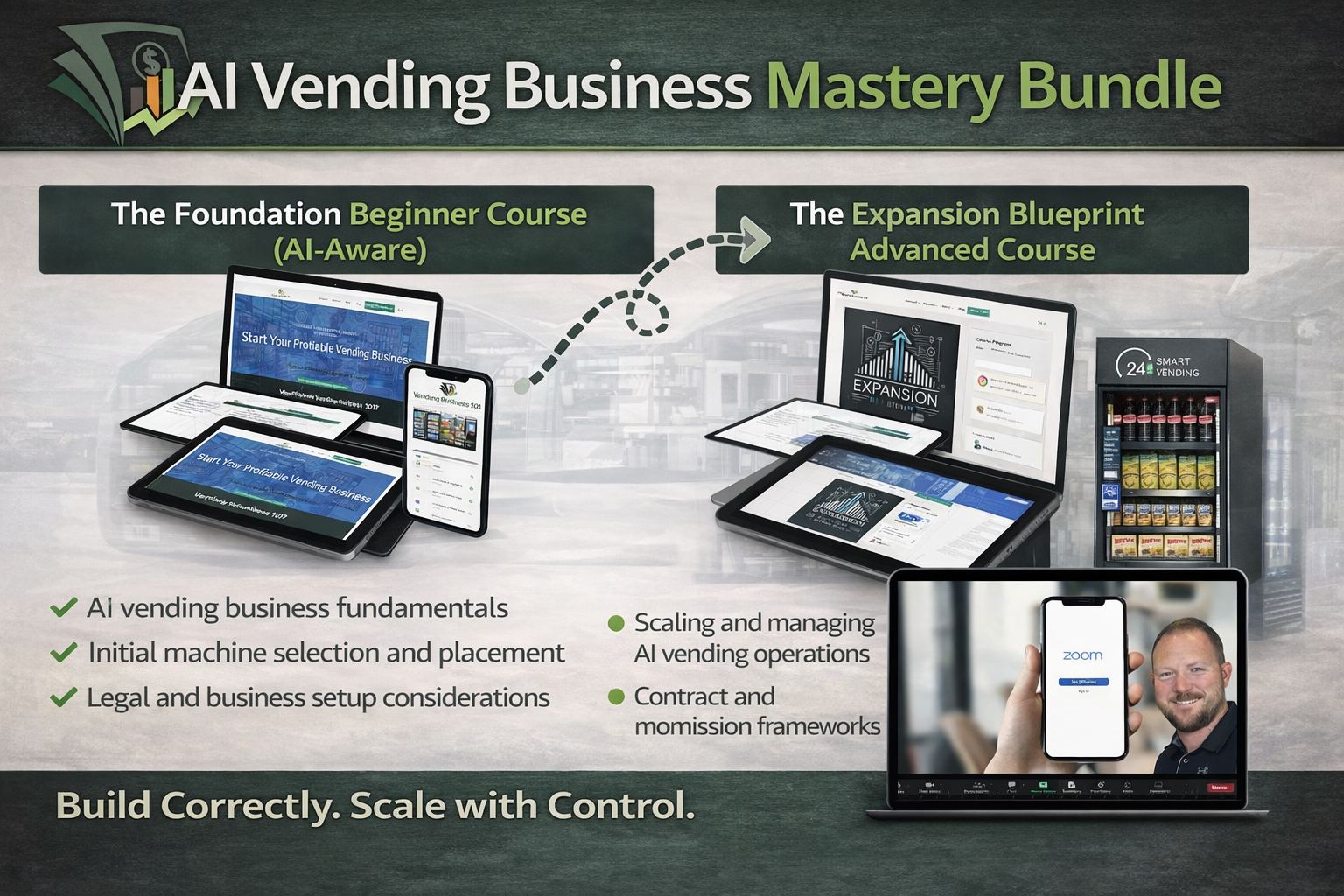
About Course
AI Vending Business Mastery Bundle
Operational Systems and Scale Control
This advanced course is designed for established vending operators who are actively operating AI vending machines or transitioning into AI vending at scale. The focus is not on starting a vending business, but on managing the operational complexity that emerges as machine count, data, and location expectations increase.
The course addresses the structural challenges unique to AI vending environments, including alert-driven service, inventory visibility, commission pressure, and hybrid route management. Content is built around operational systems, decision frameworks, and control mechanisms rather than tactics or growth shortcuts.
This is a self-paced program for operators who want to scale AI vending deployments while maintaining control over time, capital, and asset performance.
What You Will Learn
How to design service workflows that reduce stop time and variability across AI and hybrid routes
Inventory control methods that stabilize purchasing and improve data accuracy
Pricing and product mix frameworks aligned with AI machine transparency
Seasonal rotation and bundling decisions without increasing operational complexity
How to evaluate and structure commercial AI vending placements using professional economic logic
SOP development that supports delegation and consistent execution
Team and workflow structures that reduce operator load as the operation grows
Included Materials
Advanced operational templates and worksheets for AI vending environments
SOP and system design tools adaptable to hybrid operations
Certificate of completion
Lifetime access is included to support ongoing operational refinement.
Course Content
Level 1 Course Orientation
Understand what this course is designed to do, who it is for, and how AI vending differs from traditional vending from the very beginning.
Course Orientation and the AI Vending Opportunity
Level 1 Module 1: Side Hustle to Full Time Vending
Building income with AI smart coolers the right way
Why this course exists
Most people do not want to be rich overnight.
They want relief.
Relief from:
• Feeling stuck
• Feeling capped
• Feeling dependent on one paycheck
• Feeling like hard work is no longer rewarded the way it used to be
This course exists because AI smart coolers offer something rare.
A way to build income without quitting your job, without gambling your future, and without needing a perfect situation to start.
This is not a vending overview.
This is not about every machine type.
This is not about outdated equipment.
This course is focused on one thing:
Building real income with modern AI smart coolers from HaHa and Vendera.
Why?
Because clarity builds confidence.
And confidence creates action.
Lesson 1: Your first location is not about money
Lesson 2: Why AI smart coolers change everything for beginners
Lesson 3: Why vending stays alive when other income sources disappear
Lesson 4: The hidden risk in popular investment paths
Lesson 5: Why vending payback feels different
Lesson 6: The moveable asset advantage
Lesson 7: Why keeping your job is a strength
Lesson 8: Thinking like a smart cooler operator
Lesson 9: Why predictable income changes everything
Level 1 Module 2: Business Setup and Legal Awareness
This module provides vending operators with practical legal and business setup awareness, not legal advice. The goal is to help you understand what typically applies to vending businesses so you can set up correctly, ask better questions, and avoid common early mistakes.You are not expected to become a lawyer, CPA, or compliance expert. You are expected to understand the landscape well enough to operate responsibly and protect your business as it grows.
Lesson 2.1 Understanding Business Structures for Vending Operators
Lesson 2.2 Employer Identification Number (EIN)
Lesson 2.3 Licenses and Permits Commonly Required for Vending
Lesson 2.4 State and Local Compliance Awareness
Lesson 2.5 Business Banking and Financial Separation
Lesson 2.6 Tax Awareness for Vending Operators
Lesson 2.7 Insurance Basics for Vending Businesses
Lesson 2.8 Branding and Intellectual Property Awareness
Lesson 2.9 Food and Beverage Compliance Awareness
Lesson 2.10 Module Summary and Operator Boundaries
Level 1 Module 3: Finding & Securing Profitable AI Vending Locations
Where Smart Machines Actually Make Smart Money
AI vending machines do not fail because of technology.
They fail because they are placed in the wrong environments.
This module exists to teach beginners how to think like a modern AI vending operator, not a traditional snack vendor. AI machines demand control, security, and predictable behavior. When those conditions are met, they outperform traditional vending. When they aren’t, they become expensive mistakes.
This module will show students:
• Where AI vending works
• Where it absolutely does not
• Why most beginners choose the wrong locations
• How to avoid security, theft, and payment disasters
• How to identify overlooked but high-quality AI accounts
Lesson 3.1: Why AI Vending Changes the Location Game Completely
Lesson 3.2: The Non-Negotiables for AI Vending Locations
Lesson 3.3: Security First, Profit Second (This Is Where Beginners Blow It)
Lesson 3.4: Proven AI Vending Location Types (Qualified and Safe)
Lesson 3.5: Overlooked AI Vending Accounts Most Beginners Miss
Lesson 3.6: AI Vending Pitch Strategy (What Actually Resonates)
Lesson 3.7: AI-Specific Location Red Flags to Walk Away From
Lesson 3.8: Placement Inside the Location Matters More for AI
Lesson 3.9: Common Beginner AI Location Mistakes (And Fixes)
Lesson 3.10: The AI Location Selection Playbook
Level 1 Module 4: Sales and Closing for AI Vending Locations
How Smart Machines Get Approved While Everything Else Stalls
AI vending machines do not win approvals because they are impressive.
They win approvals because they are safe to say yes to.
This module teaches you how to secure AI vending locations by understanding how modern decision-makers think, how risk flows inside organizations, and how AI vending quietly removes the reasons people normally say no.
If you master this module, you will stop “selling” and start getting approved.
________________________________________
Module Objective
This module exists to replace selling pressure with approval logic.
By the end of this module, you will be able to:
• Secure AI vending locations without hype or persuasion
• Shorten approval timelines by removing internal risk
• Speak in language decision-makers repeat internally
• Calm AI-specific objections before they escalate
• Match HaHa and Vendera machines to environments correctly
• Close placements without technical explanations or pressure
This module answers one question only:
Why does AI vending get approved where traditional vending stalls or fails?
Lesson 4.0: AI Vending Negotiation System
Lesson 4.1: Why Selling AI Vending Is Fundamentally Different
Lesson 4.2: How Decision-Makers Actually Approve AI Vending
Lesson 4.3: How AI Vending Quietly Shortens Approval Timelines
Lesson 4.4: Model-Aware Sales Positioning (This Is Where Beginners Lose Deals)
Lesson 4.5: How to Speak to Each Decision-Maker Without Triggering Resistance
Lesson 4.6: The AI-Only Objection Framework (This Is the Core Skill)
Lesson 4.7: Approval-Safe Language Bank
Lesson 4.8: Closing AI Vending Without Pressure
Level 1 Module 5: Machine Selection for AI Vending
Choosing the Right Equipment for the Right Location -
Module Objective
By the end of this module, you will be able to:
• Select the correct AI vending machine based on real-world location behavior
• Understand where each HaHa AI model performs best and where it does not
• Confidently position Vendera vs HaHa based on operational differences, not marketing claims
• Use traditional machines only where they protect your AI strategy, not replace it
Machine selection is not about preference.
It is about alignment with the location.
5.1 Why Machine Selection Comes After Locations
5.2 Overview of the AI Machine Landscape
5.3 HaHa AI Vending Platform Overview
5.4 HaHa Mini 360CT
5.5 HaHa Plus 440CT
5.6 HaHa Pro 542CT
5.7 HaHa Ultra 1200CT
5.8 HaHa Frozen 550FT
5.9 HaHa 620CTS Max Series with Display
5.10 Vendera VD-5S Smart Cooler
5.11 Traditional Machines as Strategic Support
5.12 Matching Machines to Real Environments
5.13 Capital Protection Through Selection
Level 1 Module 6: Funding Your AI Vending Business
Turning Approved Locations Into Revenue Producing AssetsModule Outcome and Standards6.0.1 What you will be able to do after this moduleBy the end of Module 6, you will be able to:Choose a funding method that matches a specific AI vending placement
Explain financing in a way that makes location approvals faster and safer
Compare HaHa vs Vendera funding pressure in real placements
Build a funding stack that preserves cash while you scale
Select term lengths that match real world performance timelines
Avoid funding structures that create unnecessary pressure
Present financing as operator discipline, not desperation6.0.2 Important course disclaimer for this moduleThis module is educational only and is not financial, legal, or tax advice. You are responsible for your decisions and should consult qualified professionals for your specific situation.
6.1 Lesson 1: The AI Vending Funding Mindset
6.2 Lesson 2: The Funding Decision Filter
6.3 Lesson 3: The AI Vending Funding Stack
6.4 Lesson 4: Term Strategy and Payment Psychology
6.5 Lesson 5: HaHa Pro vs Vendera VD-5S Funding Pressure
6.6 Lesson 6: Approval Language That Makes Financing Safer
6.7 Lesson 7: The Optimistic Path Forward
Level 2 Module 1: Positioning & Market Advantage
Why AI Is No Longer Optional and How Operators Must Reposition to Survive and Grow -
Module Objective
By the end of this module, you will be able to:
• Understand why traditional vending alone is no longer sufficient for location retention
• Identify the structural forces pushing locations toward AI-enabled solutions
• Position AI vending as both a defensive and offensive strategy, not a reactionary upgrade
• Determine where AI machines create leverage and where traditional machines must still be preserved
• Make positioning decisions that protect existing accounts while creating future growth optionality
This module is not about selling more machines.
It is about remaining relevant in an environment where expectations have already changed.
1.1 The Shift: From Convenience Vending to Experience Expectations
1.2 Why Operators Lose Accounts Without Realizing It
1.3 AI Vending as a Defensive Strategy
1.4 The Hybrid Reality: AI and Traditional Machines Coexisting
1.5 Positioning AI Internally Before Positioning It Externally
1.6 Strategic Positioning Is About Optionality
Level 2 Module 2: Finding and Winning the Right Locations
Tool-Based Prospecting, Pre-Qualification, and Upgrade Targeting for 2026 Operators -
Module Objective
By the end of this module, you will be able to:
• Build a repeatable location intelligence system using named tools and simple workflows
• Generate qualified account lists without wasting time on low-ROI targets
• Pre-qualify locations for AI, hybrid, or traditional placement using a scoring system
• Identify decision-makers and contact info faster with minimal technical skill
• Use AI prompts to speed up research, filtering, and next-step planning
This module is designed to create leverage, not activity.
If it does not save time or increase deal quality, it does not belong.
2.1 The 2026 Location Game
2.2 The Operator Intelligence Stack
2.3 The Weekly Intelligence Workflow
2.4 The AI Placement Decision System
2.5 Operator Prompt Pack
2.6 Simple Tools Setup for Older Operators
2.7 Time and Money Leverage Rules
Level 2 Module 3: Contracts, Commissions & Control
How Elite Operators Design Agreements That Protect Capital, Time, and Optionality in the AI Era -
Module Objective
By the end of this module, you will be able to:
• Engineer vending agreements that defend margin, reduce renegotiation risk, and scale cleanly
• Control commission structures using leverage, structure, and optionality rather than concessions
• Negotiate AI, hybrid, and transitional agreements without weakening your existing portfolio
• Identify and neutralize hidden contract risks before they erode profits
• Apply negotiation psychology as a system, not a script
• Use tools and AI prompts to draft, audit, and pressure-test contracts efficiently
This module is not about “getting deals signed.”
It is about engineering agreements that survive AI transitions, inflation, competition, and future exits.
3.1 Negotiation as Portfolio Engineering
3.2 The Three Contract Models Advanced Operators Use
3.3 Commission Engineering: Where Most Operators Lose Without Realizing It
3.4 Contract Clauses as Profit Infrastructure (Non-Negotiable)
3.5 AI-Specific Risk Controls in Contracts
3.6 Hidden Contract Risks That Quietly Kill Profit
3.7 Negotiation Psychology Without Scripts
3.8 Exclusivity, Volume, and Expansion Rights as Moats
3.9 Tools for Contract Execution and Oversight
3.10 AI Prompt Pack: Contract Intelligence
3.11 Time and Workflow Leverage Rules
Level 2 Module 4: Tools, Repairs & Risk Management
How Elite Operators Engineer Uptime, Protect Capital, and Eliminate Downtime Drag -
Module Objective
By the end of this module, operators will be able to:
• Build a tiered repair and tool system aligned to scale
• Diagnose failures methodically instead of guessing
• Decide with confidence what must be handled in-house vs outsourced
• Reduce downtime without increasing labor or stress
• Convert every repair into prevention, data, and leverage
This module is not about fixing machines.
It is about controlling risk so machines never control your business.
4.1 Repairs as a Profit Protection System
4.2 The Operator Risk Pyramid
4.3 In-House vs Outsourced Repair Decisions
4.4 Tiered Tool Systems
4.5 High-Level Troubleshooting Framework
4.6 AI and Telemetry as Force Multipliers
4.7 Preventive Maintenance That Actually Matters
4.8 Moving, Relocation, and Physical Risk Control
4.9 Documentation as Leverage
Level 2 Module 5: Route Design & Mobile Operations
Designing Vehicles and Routes as Scalable Profit Systems -
Module Objective
By the end of this module, you will be able to:
• Design a vending service vehicle as a deliberate workflow system, not a storage container
• Engineer vehicle layouts that reduce physical strain, decision fatigue, and service time per stop
• Align route design, loadouts, and vehicle architecture to protect uptime and operator capacity
• Identify and eliminate hidden inefficiencies that quietly cap route growth
• Build mobile systems that scale across drivers, machines, and mixed AI/traditional fleets
At scale, the vehicle is not transportation.
It is infrastructure.
5.1 The Core Principle: Vehicles Are Workflow Engines
5.2 Vehicle Selection as a Strategic Constraint
5.3 The Zoning Framework: Designing the Interior Intentionally
5.4 Load Engineering: Designing the Day Before It Starts
5.5 In-Vehicle Inventory Control as Risk Management
5.6 Security as a Structural Requirement
5.7 Ergonomics and Fatigue as Capacity Limiters
5.8 Designing for Mixed AI and Traditional Fleets
5.9 Second-Order Consequences of Poor Vehicle Design
Level 2 Module 6: Inventory, Warehousing & Cash Control
This module trains operators to design and operate a capital-efficient, intelligence-driven inventory system across warehouse, vehicle, and machine layers. The objective is not better counting. The objective is control: control of cash, SKU velocity, service load, shrink, and long-term scalability while operating hybrid AI and traditional routes.
At scale, inventory is your largest silent risk and your greatest leverage point. This module reframes inventory as a capital deployment system, not an operational chore.
6.1 Inventory as Distributed Capital
6.2 The Three-Layer Inventory Architecture
6.3 Warehouse Systems: The Brain of the Operation
6.4 HaHa AI: Inventory Intelligence at the Product Recognition Layer
6.5 Vendera Platform: Inventory Trust and Loss Control
6.6 Vehicle Inventory: Execution, Not Storage
6.7 AI as the Decision Layer (Not the Boss)
6.8 Capital Control and Inventory Budgeting
6.9 Distributor Strategy as Inventory Risk Management
6.10 Why This System Works at Scale
Level 2 Module 7: Pricing, Margins & Revenue Strategy
Establish a precise, scalable pricing framework that accounts for tax mechanics, payment systems, and commission structures across AI and traditional vending. This module equips advanced operators to price intentionally, protect margins, and make defensible, data-backed pricing decisions when managing hybrid routes or transitioning capital into AI vending.
7.1 Pricing Is a System, Not a Number
7.2 AI Vending Machines: Clean Pricing Through Tax Separation
7.3 AI Machine Net Profit Formula
7.4 Traditional Vending Machines: Embedded Cost Reality
7.5 Traditional Machine Margin Compression
7.6 Visual Comparison Using Real Numbers (Industry Standard)
7.7 Compounding Effect at Scale
7.8 Industry Standards and Thresholds (2026)
7.9 Hybrid Route Pricing Strategy
7.10 Strategic Use of HaHa and Vendera Pricing Intelligence
7.11 Operator-Level Implementation (Day One)
Level 2 Module 8: Scaling AI Vending Operations
Convert operational complexity into repeatable systems so an AI vending operation can add machines, locations, and volume without increasing operator load. The operator should leave this module with a decision framework for what to systemize, how to choose the correct system class, how to write SOPs that produce consistent outcomes, and how to implement changes without creating downtime, inventory distortion, or cash control risk.
8.1 Why Operators Fail at Scaling (They Scale Chaos)
8.2 The Scale Filter Framework (Overview)
8.3 Task Inventory and Scoring (What Is Worth Scaling)
8.4 System Selection Decision Tree (What Scales It)
8.5 SOP Creation (How to Make It Repeatable)
8.6 Implementation (Pilot, Lock, Scale)
8.7 Metrics and Weekly Review Loop (Keep It Tight)
8.8 Case Studies (Application Labs, Not Examples)
Level 2 Module 9: Building a Large Vending Business
Module Objective
This module restructures how operators think, decide, and build as they transition from a medium-sized route into a large-scale vending operation. The goal is not growth for its own sake, but controlled expansion where outcomes remain stable as machines, locations, staff, and complexity increase.
Operators who complete this module will understand:
• why medium-sized businesses stall
• why large operators behave differently even when using similar machines
• how mindset shifts drive system design
• how control replaces effort as the primary growth lever
This module is not about tactics alone. It is about becoming the kind of operator who can run a large route without chaos.
9.1 The Defining Difference Between Medium and Large Operators
9.2 How Medium Operators Think (And Why That Thinking Eventually Breaks)
9.3 The Large Operator Mindset: Control Over Effort
9.4 The First Critical Shift: From Doing Work to Designing Work
9.5 Why Roles Must Change as the Business Grows
9.6 The Second Critical Shift: From “Finish the Route” to “Protect the Asset”
9.7 The Controlled Field Operator as a Scaling Lever
9.8 The Third Critical Shift: From Trusting People to Trusting Systems
9.9 How Capital Thinking Changes at Scale
9.10 The Final Shift: From Growth as a Goal to Control as a Prerequisite
Level 2 Module 10: Exits, Valuation & Long-Term Options
Engineer a vending operation that can be sold, merged, transferred, or retained without restructuring. This module provides advanced exit strategies, valuation drivers, buyer psychology, and a concrete plan to increase enterprise value using modern equipment, clean financials, durable contracts, and reduced operator dependency.
10.1 Exit Strategy Is Built Years Before the Exit
10.2 What Buyers Actually Buy
10.3 Valuation Drivers That Move Multiples
10.4 Exit Options and When Each Makes Sense
10.5 Holdback and Performance Protection Structures
10.6 Upgrade Strategy for Value, Not Vanity
10.7 The 90-Day Exit Readiness Plan
10.8 Long-Term Optionality Strategy
Master Your Vending Business Success
Earn a certificate from VendingBusiness101.com as a symbol of your expertise, to excel in the vending industry

Student Ratings & Reviews